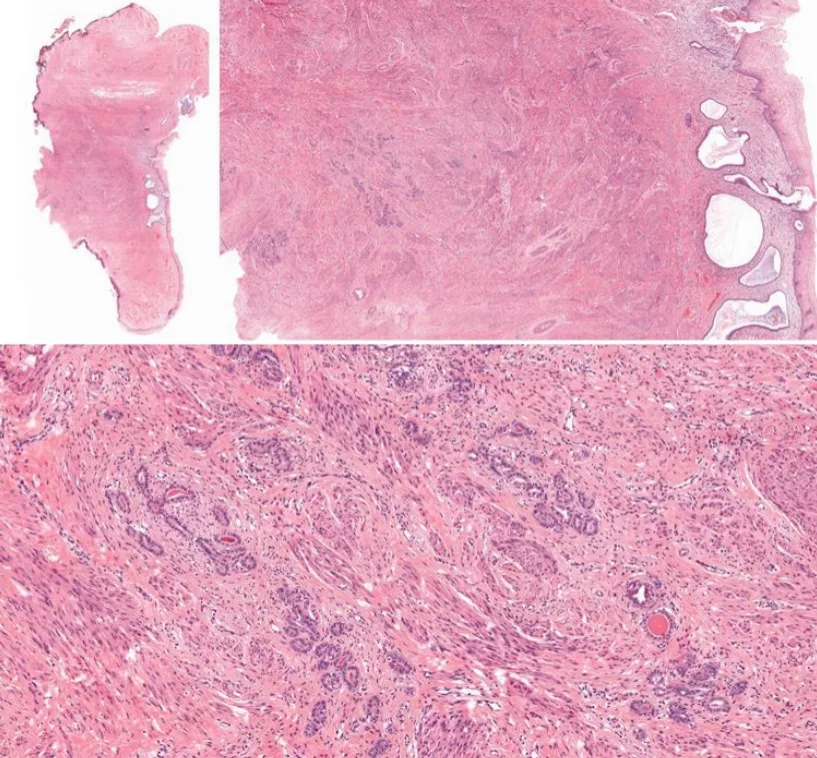
Case 9 - A 46 y.o. LADY
was diagnosed with adenocarcinoma in situ on pap smear and she underwent cervical cone biopsy. One representative section.

🎯𝘛𝘈𝘙𝘎𝘌𝘛𝘌𝘋 𝘋𝘐𝘈𝘎𝘕𝘖𝘚𝘐𝘚 🎯
- Published on
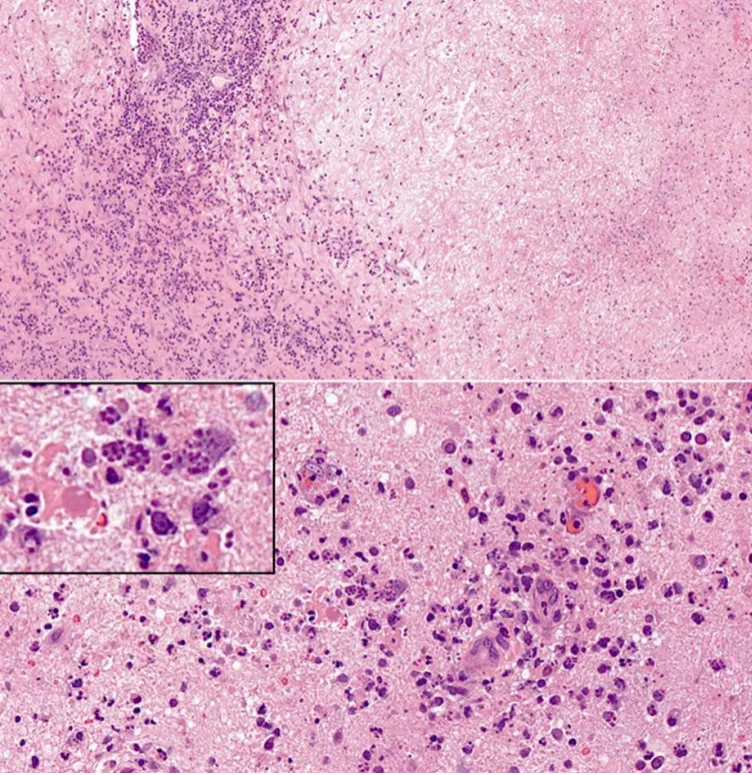
Clinical History: A 33-year-old male with underlying retroviral disease presented with altered behavior. Biopsy of the brain lesion. One representative section.
Educational notes:
1. The brain tissue fragments show necrotizing cerebritis with large areas of necrosis containing eosinophilic cellular debris. There are foci of mixed acute and chronic inflammatory infiltrates and perivascular inflammatory infiltrates. Extracellular microorganisms and rare pseudocysts are observed, morphologically consistent with free tachyzoites and bradyzoites of Toxoplasma gondii.
2. Most common differential diagnoses for intracranial lesions of AIDS patients are primary central nervous system lymphoma, progressive multifocal leukoencephalopathy, cerebral toxoplasmosis and HIV encephalitis. In this brain tissue biopsy, microorganisms with the size less than a lymphocyte are identified. Histoplasma capsulatum and Toxoplasma gondii are the main differentials. Morphologically, the former is distinguished from the latter by presence of fungal cell wall in the form of halo in H&E stain. This could be highlighted by GMS and PAS special stains. Toxoplasma gondii may be difficult to be recognized due to resemblance to cellular debris. Immunohistochemistry against Toxoplasma gondii is helpful.
Reference 1. Lee, Ashley M., et al. "Safety and diagnostic value of brain biopsy in HIV patients: a case series and metaanalysis of 1209 patients." Journal of Neurology, Neurosurgery & Psychiatry 87.7 (2016): 722-733. 2. Kradin, Richard L. Diagnostic Pathology of Infectious Disease. Elsevier Health Sciences, 2017.
1. The brain tissue fragments show necrotizing cerebritis with large areas of necrosis containing eosinophilic cellular debris. There are foci of mixed acute and chronic inflammatory infiltrates and perivascular inflammatory infiltrates. Extracellular microorganisms and rare pseudocysts are observed, morphologically consistent with free tachyzoites and bradyzoites of Toxoplasma gondii.
2. Most common differential diagnoses for intracranial lesions of AIDS patients are primary central nervous system lymphoma, progressive multifocal leukoencephalopathy, cerebral toxoplasmosis and HIV encephalitis. In this brain tissue biopsy, microorganisms with the size less than a lymphocyte are identified. Histoplasma capsulatum and Toxoplasma gondii are the main differentials. Morphologically, the former is distinguished from the latter by presence of fungal cell wall in the form of halo in H&E stain. This could be highlighted by GMS and PAS special stains. Toxoplasma gondii may be difficult to be recognized due to resemblance to cellular debris. Immunohistochemistry against Toxoplasma gondii is helpful.
Reference 1. Lee, Ashley M., et al. "Safety and diagnostic value of brain biopsy in HIV patients: a case series and metaanalysis of 1209 patients." Journal of Neurology, Neurosurgery & Psychiatry 87.7 (2016): 722-733. 2. Kradin, Richard L. Diagnostic Pathology of Infectious Disease. Elsevier Health Sciences, 2017.
0 Comments